

Jack Dokus Reflects on 50 years with Sandwich Home Industries & The League of NH Craftsman

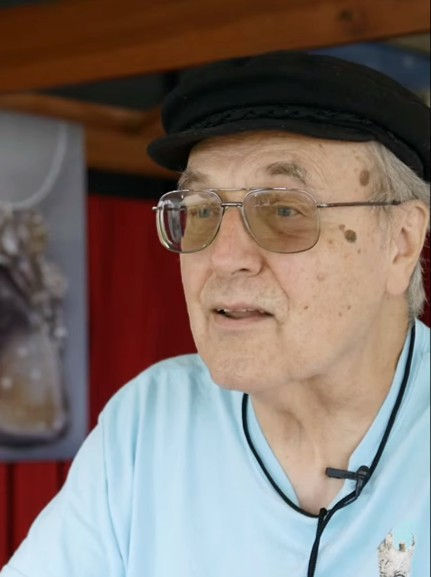
We sat down with Jack Dokus — a talented jewelry artisan, who first exhibited at Sandwich Home Industries in 1976 and hasn't looked back—to hear his story and how he's been a big proponent of The League of NH Craftsmen.

"Back in 1926 when the founding mothers got together and said, “It would be a good idea to show off our handiwork and make some much-needed money”. It worked so successfully, giving birth to The Sandwich Home Industries and The League during the Great Depression. They would have had no idea that almost a century later they would be benefiting the arts and the craftspeople" - Jack Dokus
Q: When did you first develop an interest and skills to do the intricate jewelry that you've made over the years?
Jack: I did artwork as soon as I could hold the pencil but it was in high school that I started my serious art training. I got a bachelor's degree from Kane College of New Jersey, and I taught for two years in a community college, County College of Morris. When I moved to New Hampshire in 1976, I had planned to teach art but it was hard to get a job doing that, so I was directed by fate into doing artwork. Although I have a formal fine arts background, jewelry was where I focused myself. From that time to the present moment, jewelry is what I had been doing.
Q: Can you describe your jewelry work and the process you go through?
Jack: I do a lot of sculptural work. Actually, I consider myself as a sculptor on the jewelry scale, and I do a lot of figurative work as opposed to abstract minimalism. The theme of a lot of my work is nature and fantasy.
When I get an idea, I'll sketch it out, and that is often the first step. Then I carve a model in wax. I know people assume you get it right the first time, and boy, isn't that great when that happens? But no, sometimes you redo it once, twice, three times. Then you use a special kind of casting plaster. You fill it up the plaster with molten metal. It hardens, you let it sit two hours, and then you put it in a kiln, and burn the wax out. It's a slow process because the wax is melted down to a liquid. The liquid is burned to a carbon. You cast the silver into the mold, and let that set and cool. You destroy the mold, break the plaster. You file it, polish it, finish it, set a stone. It’s a complicated process and time consuming. Sometimes my wife has understood herself as a jewelry widow. But she's very understanding, and I appreciate that.

Q: Fifty years is quite an accomplishment. Looking back, what has it meant to you?
Jack: At my age, you look back and say, well, what have I done? I have been very fortunate and blessed to be able to be creative, have some visions, and actually bring that into a product that you can hold in your hands and hope someone will buy and cherish. I do a wide variety of work and price ranges so it's affordable for people who just want a pair of earrings with a stone and a little design. I also do museum pieces that take hours upon hours of sculpting and working and designing. I've done both things. It's very satisfying, and although I never made a lot of money, that wasn't always the motivating factor.
Q: What is the significance of Sandwich Home Industries having a 100-year anniversary and still thriving?
Jack: Back in 1926 when the founding mothers got together and said, “It would be a good idea to show off our handiwork and make some much-needed money”. It worked so successfully, giving birth to The Sandwich Home Industries and The League during the Great Depression. They would have had no idea that almost a century later they would be benefiting the arts and the craftspeople. It's not just that one has a market to sell their work, but you have a community of fellow artists to confer with one another and join in a common cause.
The people who work there are hardworking and industrious, and proud of their effort in marketing the work of the craftspeople. It’s remained generation after generation, evolved, and improved. I can't say enough about the Industries and the League. Having done it for almost a century, yeah, that's pretty special, and I'm happy to be part of it.
Q: How has the League of NH Craftsman benefited you?
Jack: The League has helped me with raising a family, not just financially, but the League was a great example for my children to see other individuals who worked hard. It didn't matter if they were a man or a woman; they saw the work that they produced, there was no favoritism of gender in any way. I have two sons and a daughter, and they were able to see that and accept that's the way it should be done. The League has been a great help, both emotionally and financially, but it's the combination that really makes it one of the foremost arts organizations in the country.


Comments