

One Hundred Years of Sandwich Home Industries

Updated: May 5
A Talk by Martha Nichols on the Occasion of the Centennial, March 2026

Sandwich Home Industries, founded in 1926 in Sandwich, New Hampshire, has been a cornerstone of the town’s creative and economic life for a century. What began as a modest rug exhibition organized by a few dedicated women grew into a cooperative craft enterprise that helped shape the League of New Hampshire Craftsmen — the first state-supported craft organization in the United States. From its origins in a rented storefront on Main Street to its current home on the village green, the organization has weathered fire, depression, and pandemic while sustaining a tradition of handmade craft, community education, and local artistry that continues to thrive today.
A Rug Exhibition Sparks a Movement
It all started with a rug exhibition in February 1926. The Samuel Wentworth Library and the Sandwich Historical Society joined forces to organize a two-week exhibit at the library, inspired by the growing national interest in rural handicrafts. Rug making had long been a practical and creative outlet for rural women, who could use up old clothing and blankets in the process, and city buyers were increasingly eager to purchase such handmade goods.
The exhibition committee was headed by Mrs. J. Randolph Coolidge — known as Mary Coolidge — and included Mrs. Carl Beatty, Mrs. Alonso McCrillis, Mrs. Charles B. Hoyt, and Miss Mabel Quimby. The show featured one hundred rugs, old and new, made by Sandwich women. Mr. Chandler of Jordan Marsh was brought in to judge the rugs on color, design, and marketability, and over seventy people crowded the library for the opening lecture. A local reporter for the Sandwich News wrote that the success of the event suggested “a cooperative rug industry will be started in Sandwich” using wool grown and spun locally. Most of the rugs were sold.

The success of the exhibition prompted the committee to open a shop to sell items made by Sandwich citizens. They called it the Sandwich Home Industries, and it has been in continuous operation ever since. The organization was not entirely without precedent: in 1898, Helen Albee, a summer resident of Silver Lake, had established the Abnaki Rug Industry, considered the first rural industry in America to develop rug making as a handicraft. It operated until 1918. Sandwich Home Industries built on that spirit, but gave it a lasting institutional form.
Mary Coolidge: The Moving Force
While many dedicated women and men contributed to the organization’s founding, Mary Hamilton Hill Coolidge deserves particular recognition. She was, by all accounts, an enthusiast in whatever she undertook. She recognized that her Sandwich neighbors were making excellent rugs and textiles, saw a ready market for them, and understood the urgent need for rural families to support themselves. Life was hard in the 1920s: small farms in Sandwich were unprofitable, many residents had moved to cities for work, and rural households still lacked basic modern conveniences such as electricity and indoor plumbing.

Mary Coolidge and her husband had spent summers in Sandwich, retiring there permanently in 1924 in their sixties. Her purpose in helping create Sandwich Home Industries was to encourage local women to hook, braid, and weave marketable rugs — and in doing so, to sustain a craft economy for the town. She is remembered as the moving force behind both the formation of Sandwich Home Industries and, later, the League of New Hampshire Craftsmen.
Opening Day and the Early Years
Sandwich Home Industries was born as a cooperative venture in July 1926, involving the Wentworth Library, the Sandwich Historical Society, the Quimby Trustees, and Mary Randolph Coolidge. The shop leased the Heard store on Main Street — later known to many as Billy’s Store and eventually as the Sandwich General Store — and the Baptist Ladies Aid allowed use of the Christian Endeavor Hall as a tea room free of charge. Tea was served every afternoon and luncheons were held using table linens woven by Sandwich craftswomen. The shop was careful not to compete with Mr. Dearborn’s nearby store, which sold eggs and milk.
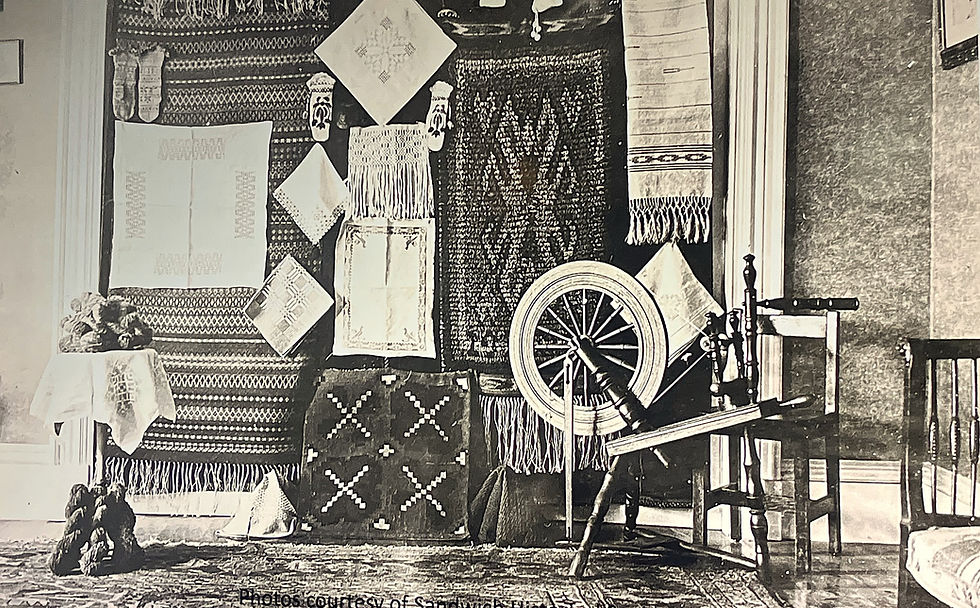
Opening Day was July 8, 1926. The sales room was open from two o’clock to five o’clock, staffed entirely by volunteers, and no commission was charged to artists that first season. To cover expenses, volunteers served tea and sandwiches during shop hours. Total craft sales for the first summer came to $1,063.44 — equivalent to roughly $19,000 today. Items sold included hooked, braided, and woven rugs; quilts; iron fire forks; fancy needlework; aprons; stockings; woven table covers; towels; dresses; candy; and food.
As the organization grew, it moved to a second location near where the post office stands today — the Merrifield Building. Louisa Moulton became the first manager of Sandwich Home Industries. She found the Merrifield building in poor condition, but Randolph Coolidge, a renowned architect, devoted considerable effort to transforming it into a welcoming sales room and tea room. He and Mary paid for the conversion themselves. When Mr. Coolidge died suddenly in 1928, the building was purchased by subscription — an early form of crowdfunding — by the people of Sandwich as a memorial to him.
The Great Fire of 1934
Tragedy struck in 1934, when the Great Fire of Sandwich swept through Main Street on a cold February day. Strong winds and snow-drifted roads made it nearly impossible for firefighters from Sandwich, Moultonborough, and Center Harbor to reach the scene in time. The fire started in the basement of the adjacent Merrifield store and quickly spread; the Sandwich Home Industries building was among the six or seven that burned. Fortunately, townspeople had rushed to empty several buildings beforehand, and most of the furniture and crafts were removed before the shop was fully consumed.

In the aftermath, the town made a collective decision to widen Main Street and redesign the entire area, setting buildings further back from the road to prevent embers from jumping across — as they had done, reaching Thompson’s Garage and nearby houses. The village green, now known as Quimby Green and owned by the Quimby Trust, was created from the former Thompson Garage and basket shop lot. Despite it being the depths of the Great Depression, the town rebuilt, widened the road, and added the green all within a year.
The J. Randolph Coolidge Memorial Foundation purchased lots on the new green for a permanent home for Sandwich Home Industries and hired architect Harry J. Carlson — a colleague of Mr. Coolidge — to design a new building at 32 Main Street. That building, with its distinctive roof-within-a-roof design, remains the home of the organization today.
Birthplace of the League of New Hampshire Craftsmen
One of Sandwich Home Industries’ most significant legacies is its role in the founding of the League of New Hampshire Craftsmen. As the Depression deepened after 1929, the handicraft movement gained new urgency. Louisa Moulton, the industries’ manager, gave speeches at the University of New Hampshire urging the state to provide craft instructors to rural villages as a means of improving economic conditions. Mary Coolidge and the industries’ members worked energetically to promote crafts and sales.
Around the same time, a silversmith and coppersmith named Cooper Ballantine, a craft instructor in Wolfeboro, took notice of what Sandwich was doing and became interested in broadening the scope of craft education statewide. He and Mary Coolidge joined forces, formed a committee, and persuaded Governor John Winant to support a state commission for the arts and crafts. In 1931, Governor Winant established the New Hampshire Commission of Arts and Crafts — the first state-supported craft entity in the United States, created to boost the economy by promoting local handicrafts. This directly led to the founding of the League of New Hampshire Arts and Crafts (now the League of New Hampshire Craftsmen) in 1932, with its emphasis on education and quality standards, and to the first national craft fair in 1933.
Mary Coolidge served as the League’s first president, holding the position until 1941, and later received an honorary degree from UNH for her contributions. League headquarters was established in Concord, with shops initially in private homes and on front porches. The League grew to include 47 local groups and 23 shops. Interestingly, Sandwich itself did not join the League until 1933 — a year after its founding — because members had voted to represent only Sandwich craftspeople in their shop. It took some persuasion from Mrs. Coolidge to convince them that joining would serve their interests. Because of this, Wolfeboro holds the distinction of being the first League shop.

The League organized its first Annual Craftsman’s Fair at the Crawford House in Crawford Notch in 1933, and the fair has run continuously ever since. It eventually moved from Crawford Notch to Sunapee State Park. The League changed its name in 1968 to the League of New Hampshire Craftsmen, and the 1960s and 70s brought an enormous surge of interest in handmade craft. Young people seeking a more creative and unconventional lifestyle — the so-called “back-to-the-landers” — swelled the ranks of juried artists; roughly 200 newly juried artists came through in 1972 alone, compared to 80 in 1960. Today the League operates five galleries across the state, with a small satellite presence at a welcome center.
A Living Tradition
Sandwich has maintained a rich and continuous craft tradition. Many of the crafts practiced in the 1920s — pottery, textiles, fiber arts, sculpture, woodworking, ironwork, and fine art — are still practiced in the town today. The gallery currently represents roughly 150 to 200 juried artists and is open seasonally. A fiber arts group meets at the building weekly, and the education program offers classes and workshops throughout the season, including clay slab, mosaics, knitting, spinning, Shibori dyeing, rug braiding, weaving, needle felting, batik, printmaking, and glass fusing. Winter lecture series featuring guest speakers have also been a regular part of the program.
In 2024, a Community Gallery was established within the building to support economic opportunity in the broader Lakes Region, including artists from Holderness, Center Harbor, Moultonborough, and Tamworth. The goal is to encourage and support craftspeople who wish to become juried members of the League.
Each year during Sandwich Old Home Week, the organization hosts the Artisans on the Green craft fair, featuring around thirty or more artisans, craft demonstrations, activities for children, and food. What began as an informal art show where anyone could hang up something they had made has grown into a popular regional event.
Looking Ahead
As it enters its second century, Sandwich Home Industries is investing in the future. Plans are underway to expand and winterize the lower level of the building, making it wheelchair accessible and adding a ceramic studio, a printmaking studio, and additional classroom and exhibition space. Work has already begun. These improvements aim to make the organization more accessible and to support expanded year-round programming for the community it has served for one hundred years.
From a modest rug exhibition to a cornerstone of New Hampshire’s craft movement, Sandwich Home Industries has demonstrated the enduring power of community, creativity, and collaboration. What a few dedicated women set in motion in 1926 — a belief that rural craftspeople deserved both a market and a home — grew into an organization that helped birth the League of New Hampshire Craftsmen and shaped the course of American craft education.
Its legacy is not only in the objects it has helped produce and sell, but in the generations of artisans it has supported — and the broader movement it helped inspire across the state and beyond. One hundred years on, that mission is as alive as ever.


I would like to correct one fact that was given in this excellent history of the Sandwich home industries. The artisans on the Greene did not begin as just a few artisans showing up to sell their wears. The first 2 to 3 years the artisans on the Greene drew as many as 80 artisans who were required as part of their registration to give educational classes at their location while they were selling their artwork. The artisans on the Greene has continued to this day with professional artists from throughout New Hampshire as well as other states
I was honored to be one of the founders of artisans on the Greene as well as the industries president for over…