

Unearthing a Century of Craft: The Story Behind "Beauty & Utility"

Updated: Jul 17
Lauren Hansen and Franz Nicolay share how community treasures, archival discoveries, and 100 years of craftsmanship came together in the centennial exhibition.

"The start of the Home Industries was an inspiration for a number of other organizations. People from other states and other countries came to see what Mary Coolidge was doing and said, 'We want to do something like this. How can we do what you’ve done?' It spawned a whole movement." - Lauren Hansen
Q: How did the idea for an exhibit about the Sandwich Home Industries centennial come about?
Lauren: A few years ago, I was walking over to the post office, and the Industries had a sign out that said, “96th season.” It just popped into my head that this would be a great exhibit for the centennial summer! I put the idea on the shelf, and then we came back to it over the past year to really dig into it.
Q: How did you two team up on the project? After you had the idea, how did you approach Franz?
Lauren: We have an exhibition committee that Franz serves on, so it just kind of naturally happened. Because of his vast experience managing the gallery and organizing exhibitions at Holderness School, it was a natural fit. He has a good eye for putting things together in the space. We also have other people who help with research, outreach, and all sorts of other tasks.
Q: How did you conceive “Beauty & Utility”? How was your approach different from previous exhibits?
Lauren: The main difference was the tremendous community collaboration. Although we had items in our in-house collection, we also needed to reach out to Sandwich residents, past and present, to get as many examples of art and memorabilia as we could.
Franz: I composed a letter and sent it out on the Sandwich Board. We asked families who might have artifacts from the Home Industries spanning the last 100 years to share items representing different decades. Several families generously approached Lauren, and I contacted a few others. Lauren’s mom, Nancy, also contacted people. In the end, we had quite a positive response from the community.

Lauren: Obtaining the Mary Coolidge portrait on loan from the New Hampshire Historical Society was also a big get.
Q: So, here you are gathering all this memorabilia from the last 100 years. You’ve done this outreach. Did you discover any big surprises?
Franz: I had two surprises. First, Jim Mykland, Nancy Hansen, and I went down to the League headquarters in Concord to do research in its archives. We were poring through folders that probably had not seen the light of day in many, many decades. Jim discovered a few pages of Mary Coolidge’s notes from the first meeting that detailed the initial rug-hooking show, which was an amazing find. Then, together we uncovered her husband’s sketches for the initial logo or branding of the Home Industries. He was an architect and loved design.

If you look at the front of the building today, that square format on the southwest side of the building is still connected to those original sketches he created. Finding them on graph paper in a manila folder and seeing how his vision for the organization’s visual branding unfolded was a really exciting discovery. I don’t think anyone in recent years had seen them before, so it was fun to share them in the exhibit.
The second surprise for me was going over to Linda Marshall’s home and selecting a stunning platter that showcases Linda’s sumi-e brushwork ability and her husband Derek’s exceptional throwing skill. She and Derek operated the Sandwich Kiln for many years and were one of the reasons I first moved to town as a young, aspiring craftsman. I talked to Linda about their connection to the craft movement, to Sandwich Home Industries in general, and about our shared experience of being potters at the Sunapee Fair. Together we decided on this beautiful platter as a signature piece for inclusion in the exhibition.
Lauren: The surprise that jumps out to me was one of the last things we actually received. In our call for objects, multiple people mentioned these tiny carved wooden animals. The kids used to love buying them. They were so cute, and nobody knew where to find any. Then, at the last minute, when we were starting to put the room together, Martha Nichols dropped off a package. Inside was a collection of those carved wooden animals. So that was nice.

Q: Was there a roadmap or schematic of the layout that you put together ahead of time?
Lauren: Mentally, yes. As things progressed and we found more materials for the exhibition, I started seeing the layout in my head. There are two separate spaces in our exhibit room. I envisioned the history of the Coolidge family and the buildings in the first area. Then, as visitors walk through the opening, they encounter all the things that were sold throughout the many decades.
In my head, I wanted that second space to be representative of the photographs of the old showrooms. That idea is reflected in the glass case and the island of furniture. If you look through old catalogs of the Home Industries, you see similar vignettes of objects.
Franz: The whole exhibition has to tell a story, beginning with the introduction as you enter the gallery and unfolding from there. Lauren knew how she wanted to set up the interior walls. As you pass through, there’s an island and a peripheral walk-around space around it. Once you have that physical structure, you can start telling the story within it and see how it develops from there. The addition of the early Tea Room table and chair gives visitors a flavor of what it might have been like to visit the Home Industries during an earlier decade.

Q: How did the name “Beauty & Utility” come about?
Lauren: I was looking through an old article from the 1930s and found similar wording about Sandwich Home Industries, Mary Coolidge, and the whole process. It was not those exact words, but it was similar, and we kind of expanded on it. I found the reference in the fabulous scrapbook that Louisa Moulton kept. She was the manager for the first 20 or 30 years of the Home Industries.
Franz: Lauren made the final decision. We had a list of about 15 different possibilities for the title, and then we narrowed the list from there. What has a good rhythm? What’s concise? The main title has to be clear and direct, powerful, and eye-catching. We were dealing with the Home Industries—creating works of art that you can use—so it really fell together.
Q: Why is the story of 100 years of Sandwich Home Industries important to the town?
Franz: The storyline is so interesting because it has definite local interest. Sandwich Home Industries is right in the center of town, just off the town green, as is the Historical Society. They are sister organizations, in a way, and have been connected for a long time because Mary Coolidge first came to the Historical Society to talk about creating a show of rugs. Right from the very beginning, there was this interconnection between the two organizations. When you have two organizations that are physically central to the town itself, there’s energy there.
There’s energy in the center of town, and if the organizations are working together in a creative way, drawing upon both art and history, their work can have a powerful impact not only locally, but far beyond the town. As we found through this project, Sandwich Home Industries became a model for organizations in other states and countries.
Lauren: The start of the Home Industries was an inspiration for a number of other organizations. People from other states and other countries came to see what Mary Coolidge was doing and said, “We want to do something like this. How can we do what you’ve done?” It spawned a whole movement.

Q: Can the story of Sandwich Home Industries be a model for the future? Just as Mary Coolidge wrote 100 years ago, “A gallant stand against a machine age,” can it be a counter to our age of AI and automation?
Franz: I will tell you from personal experience. I wanted to come to a town that has a long tradition, a long history, and respect for craft work and creative work. Back in the 1970s, there was a whole resurgence of interest in crafts and handmade work that had its origins in the early postwar years of the 1950s. Now we’re seeing a resurgence again, with a new generation of young people wanting to work in an analog format. This is a perfect town for young craftspeople to come to and find support for their burgeoning creativity.
Lauren: Like Franz said, going analog has an important place in a digital world. Let’s step away from AI and computers and all that kind of stuff, work with our hands again, use our imaginations, and be creative. There’s a real need for handmade objects and a personal touch.
Franz: It makes for a much richer experience than using something anonymous. Each time you hold an object, you can’t help but think about the artist who created it as you’re using it. It has its own story. The more you can fill your day with creative associations, the more encouraging it is, and the more they add to the flavor of your life.
Q: Can the attention from this exhibit and anniversary give momentum to Sandwich Home Industries and the League of New Hampshire Craftsmen?
Franz: I personally hope it will, both locally and on a state level. From talking with the League’s director, Kate Saunders, I know that she is very interested in highlighting Sandwich Home Industries at the opening of the annual Craftsmen’s Fair. They’re looking six years down the line to celebrate the 100th anniversary of the League. The Sandwich Historical Society has done the footwork for them, in collaboration with the Home Industries. If you know your roots, you can expand your branches.
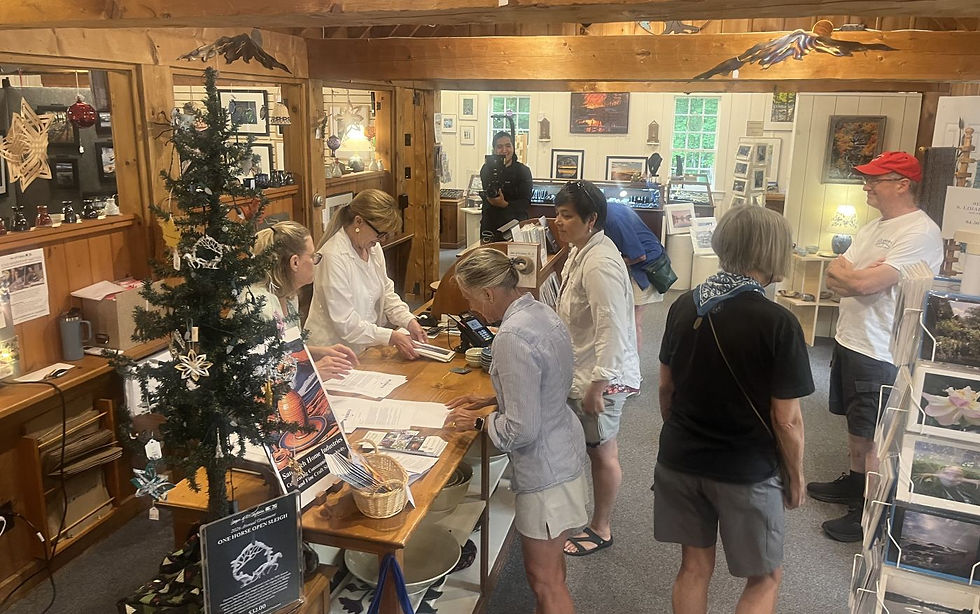
The Fine Craft Gallery at Sandwich Home Industries today.


Such an interesting article, Chris. I love reading about the history as well as the long collaboration between the Historical Society and Sandwich Home Industries. Well done!